
Dear English-speaking friends, I’d like to introduce you to my new novel:
Glück | Literarizität | Widerstand. Die Repirolisierung des Digitalen
(Happiness | Literariness | Resistance: The Re-Oriole-ization of the Digital)
Published in 2026 by The Borderlord Books (ISBN: 978-3-5657-8583-4), this book is a literary experiment at the intersection of digitalization, artificial intelligence, philosophy, politics, and, of course, love. It explores what it means to be human in a world increasingly shaped by data, algorithms, and optimization—and how literature, cultural diversity, ecological responsibility, and social justice might help us imagine a different future.
The book is currently available in German. In October 2026, it made it into the Top 100 in the ‘Kolonialisierung’ category on Amazon Germany. If you read German, I’d be delighted if you took a look—and I’d love to hear what you think.
Buy the book here:
ePubli (best for the author, cheap international shipping to UK, USA etc.)
Dussmann (best choice for Berlin)
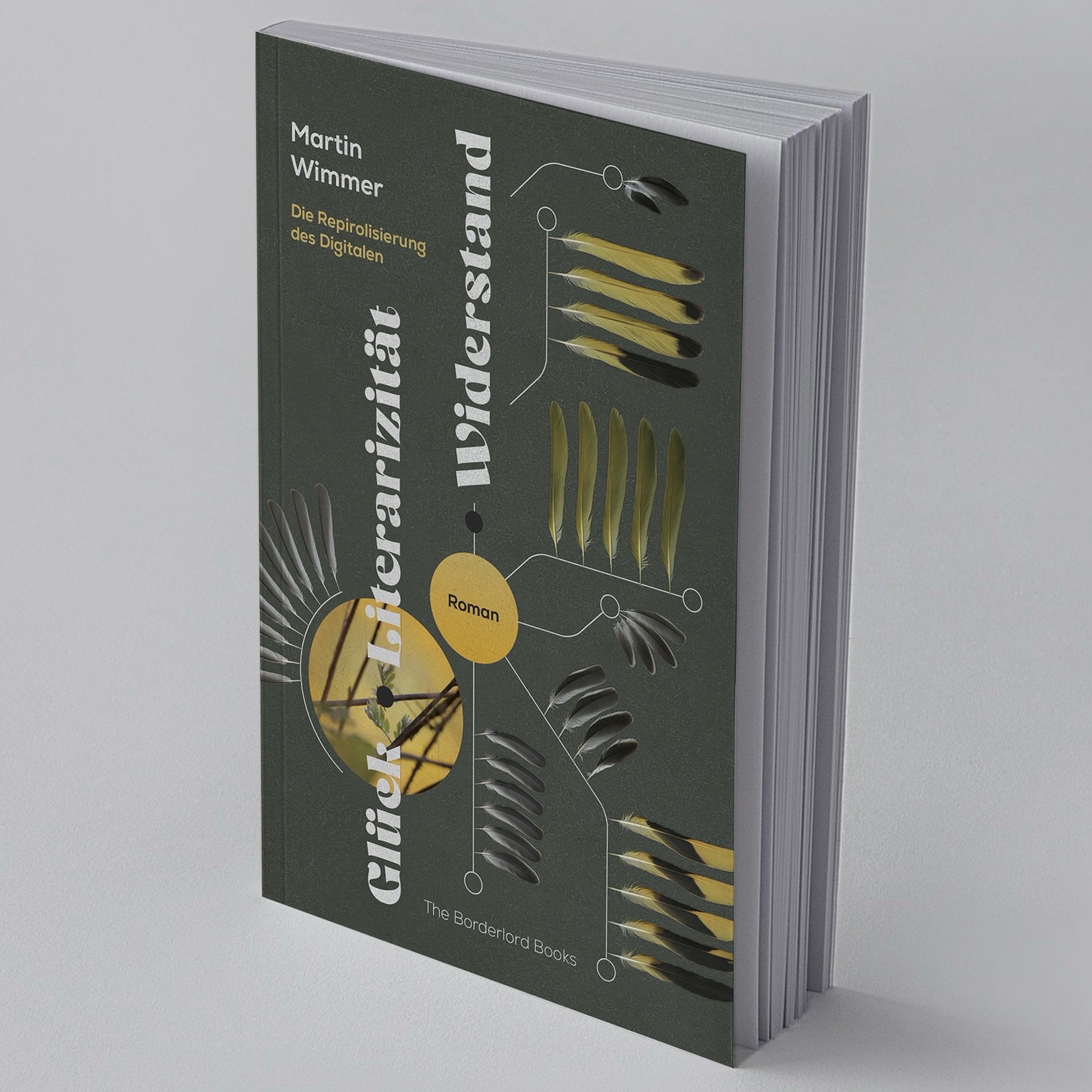
Deus ex Machina: Martin Wimmer’s Glück | Literarizität | Widerstand. Die Repirolisierung des Digitalen – An Introduction
Whether Glück | Literarizität | Widerstand is even a novel is the central question of poetics that author Martin Wimmer makes the starting point of his engagement with digitalization. Here, digital transformation is not merely a backdrop but a mode of producing reality. Digitalization damages the beautiful, the true, and the good. It must therefore damage the form of the novel, too. The book is an anomaly in contemporary literature: someone is seriously experimenting with how much non-novel a novel can withstand, how much resistance to digitalization digital transformation can contain. In German literature, which all too often considers itself contemporary simply because its characters send text messages, this is highly unusual. The book refuses both to domesticate the digital as a fashionable accessory of the present and to elevate it into a deus ex machina. A book is not a machine. Texts are not numbers. In this book, language is not supposed to transmit information. It may stumble, should seduce, must get on your nerves, can be funny, and wants to refuse.
Wimmer writes against the very logic of optimization he criticizes politically. His novel does not aspire to efficiency. It wants to produce excess. The excess is methodical. You will not read this book linearly. You will browse with twenty tabs open, click in staccato bursts, and scroll endlessly. Addictive dissolution of boundaries. An intoxicating abundance. Wimmer’s narrators know too much, are in love with their own ideas, and are far too reluctant to let a thought go without also stating its opposite. To tell the story of the digital present in all its grotesque simultaneity, the book risks embarrassment, overwhelm, and pathos.
You will want to cut this book down to size. You will disagree with it, angrily underline sentences, and skip paragraphs with a shake of your head. Endless bibliographies, meandering passages of theory: some of it reads like a seminar on speed, where a perfectly respectable speech act spirals into an anarchic orgy. And yet, from this grandiose, megalomaniacal work, you will learn more about digitalization and find more to admire about literature than in very, very many other books on the market.
Wimmer has a palpably verbal-erotic fixation on digitalization. He caresses every pore of its body. But he despises the pimps for whom it climbs into bed. His fluid narrators are radical: radically honest and fantastical. Radically personal and socially conscious. Radically disparaging and loving. Radical in their enumeration of the data of the present day and in their narration of timeless values. Radical in their fragmentation and their holistic vision. With their swagger and polemics, Wimmer’s first-person narrators manage to offend almost everyone currently engaged in public debate on the subject. And yet they win the hearts of all those for whom humanity still matters.
The oriole of the subtitle knows the way to salvation. From the freedom of the heights, it looks down on the goings-on of the internet, that locus terribilis, and always returns to a place of love. The body and the natural world play a significant role in the book. These passages are unexpectedly tender. Wimmer’s surreal dismemberment of words, absurd neologisms, abrupt shifts in register, and variations on repetition can be read as a revival of Dadaist techniques. He attacks the compulsion to reason, instrumental rationality, and bourgeois order with nonsense and provocation, fantasy and improbability. Automation and autobiography, the internet and interpretation: he engages with all of them intelligently and anti-authoritarianly.
Dada instead of data is perhaps the shortest formula for the novel. Bits and kisses would be another. Sentences need not always convey propositions. They may be material, sound, rhythm, color. In the semantic and syntactic turbulence of speech lies literature’s resistance to a digital culture that reduces language to exploitable input and quantifiable output.
The political poetry with which this book dreams about technology casts a spell. Against the ephemeral memes of the moment, Wimmer offers a memento mori; against the breakneck speed of AI, he raises a resounding O tempora, o mores! The spiraling pull ends in collapse, in blackout; the black rectangle is switched off. Beneath the language games lurks a grave psychological and physical overload. Society and the individual are subjected to an analysis of their condition, yet both yearn for love. Fragmented into names, images, and quotations, the book’s characters circulate as media fragments. Their hope is to be pieced back together into a self that is not measured but narrated, loved by a you. This book is at its strongest when it tells of lovers and the wounded.
Martin Wimmer’s Glück | Literarizität | Widerstand wants to be a novel, a scholarly lecture, an essay, a polemic, a declaration of love, and a literary hack into the operating system of the present. The written word oscillates between fact, narrative, and emotional outburst; the act of reading shimmers just as restlessly. This is excessive—and fascinating precisely for that reason. For all its glittering, overflowing form serves a purpose: to distrust every totalizing narrative. Wimmer boldly counters the technocrats’ myths of progress with visions of happiness of his own: the impossible can be collectively reimagined and individually brought to life through love.

